Low-Carbon Mortar in Parking Structures: Case for Lifecycle Thinking
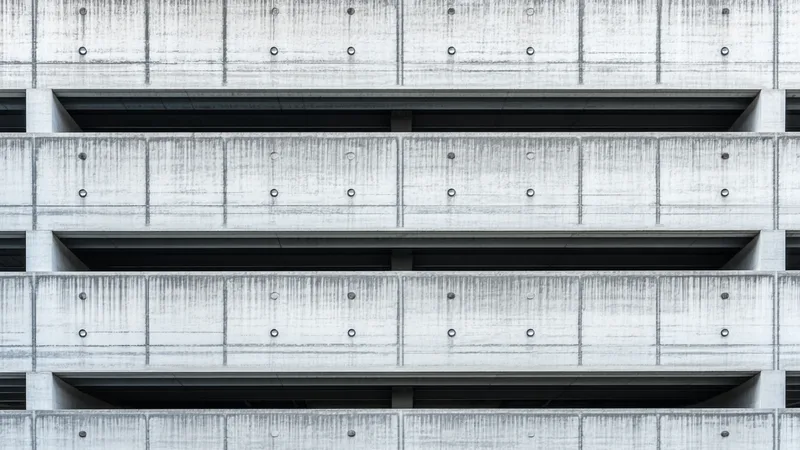
Parking structures occupy a peculiar position in the building owner's maintenance budget: they are critical infrastructure, they are expensive to repair, and they are among the most reliably under-maintained asset class in the commercial real estate inventory. The combination of environmental exposure, loading pattern, and drainage geometry makes them among the most demanding concrete environments outside of marine and highway bridge applications. Yet because they are not visually prominent and because deterioration progresses slowly enough to be deferred year over year, the maintenance cycle typically arrives as a large-number capital event rather than a managed operational cost.
The mortar specification decision at construction or major rehabilitation is where that lifecycle trajectory gets set. Getting it right — from a durability standpoint and from a carbon standpoint simultaneously — requires holding two analysis timeframes in view at once.
The Parking Structure Environment: Why It's Harder Than It Looks
Multi-level parking structures in Northern US climates experience a concentrated version of the deterioration conditions that challenge all concrete infrastructure. Deicing salt tracked in by vehicles accumulates on driving surfaces, is carried to drains by tire splash, and migrates into cracked deck slabs or mortar joint surfaces during wet-dry cycles. Drainage geometry in poorly maintained structures concentrates chloride at specific low points — expansion joints, column-beam intersections, and stair cores — which typically show the earliest and most severe deterioration.
The freeze-thaw cycle in parking structures differs from bridge decks in an important way: indoor levels 2 through N are partially sheltered from direct precipitation but experience humid air circulation that keeps concrete surfaces wet longer during freeze events than fully exposed outdoor decks would. This extended moisture presence during freezing increases pressure cycle severity in the concrete pore network. Air entrainment at appropriate levels — ASTM C260 specification, typically 4.5–7% for moderate-to-severe exposure per ACI 318 Table 19.3.3 — is non-negotiable in structures built for Northern climates.
Structural movement is the third factor. Post-tensioned parking decks deflect under vehicle loading, generating micro-crack initiation at high-moment zones. Temperature differential between the sun-exposed top level and sheltered lower levels creates differential thermal strain across frame members. These movement sources are predictable and manageable through joint spacing and proper structural detailing, but they are not fully preventable — which is why crack management chemistry is a durability tool, not a design substitute.
Where Mortar Fits: Repair, Topping, and Joint Pointing
Mortar in parking structures shows up in three distinct roles, each with different performance requirements. Repair mortars address spalled or delaminated sections of existing decks, restoring profile and concrete cover to rebar. Topping mortars (typically polymer-modified or fiber-reinforced) are applied over prepared existing decks as wear-course protection systems, particularly after selective depth repair. Joint pointing mortars seal precast panel joints, preformed expansion joint adjacent zones, and column base perimeters — the highest chloride-accumulation locations in most structures.
The performance requirements diverge across these three roles. Repair mortars must achieve high bond strength to the substrate (ICRI recommends minimum 1.4 MPa pull-off strength in most guidance) and must match the thermal expansion coefficient of the parent concrete to avoid differential strain at the repair boundary. Topping mortars must balance hardness (abrasion resistance) with enough tensile flexibility to accommodate substrate movement without reflective cracking. Joint pointing mortars must resist chloride penetration and maintain adhesion through the freeze-thaw cycling that joint zones experience disproportionately.
The conventional approach to all three has been rapid-set Portland cement-based mortar products — effective in terms of early strength, but optimized for speed rather than durability or carbon content. They are specified because they are familiar, not because the lifecycle math favors them.
The Lifecycle Carbon Arithmetic
Consider a representative scenario: a 1,200-space mixed-use parking structure in a cold-climate urban market, built in 2005, showing signs of early deterioration at the top deck and in stair tower slabs by year 15. A conventional repair program at year 15 — selective depth repair with rapid-set mortar, traffic coatings reapplication — costs approximately $400,000–600,000 for a structure of this scale in 2024 US market conditions (excluding traffic and revenue disruption). The carbon associated with that repair campaign includes the mortar material production, the traffic coating system, and critically, the diesel equipment (hydrodemolition, vacuum extraction, compressors, crew vehicles) mobilized for the work.
If the same structure had been specified with a low-carbon self-healing mortar system at the initial construction, with higher gel-matrix content reducing chloride ingress rate over the first 15 years, the deterioration progression to year 15 would have been characteristically slower in the critical zone. In laboratory conditions, gel-matrix mortars show reduced chloride diffusion coefficient relative to comparable Portland cement mortars — the relationship is application-specific, but the mechanism is well-established in the materials science literature. Even a modest 25–30% reduction in chloride penetration rate, if sustained, shifts the repair trigger point from year 15 toward year 20–22, deferring the repair campaign and the associated carbon cost by 5–7 years.
We're not claiming specific lifecycle cost savings numbers — those depend too heavily on site-specific variables to be generalizable. We are saying that the lifecycle carbon accounting which only looks at initial pour emissions is systematically missing the most carbon-intense event in the structure's life: the emergency repair mobilization that happens before the planned rehabilitation.
Low-Carbon Mortar Mix Design Considerations
Parking structure repair and topping mortars are typically factory-blended, prepackaged products — unlike structural concrete which is batched at a ready-mix plant. This changes the supply chain for SCM incorporation: slag or calcined clay needs to be blended into the dry mortar product at the manufacturer, not sourced by the concrete producer. The implication for engineers is that specifying a low-carbon mortar means requiring a minimum percentage of binder from SCM sources in the product formulation, not simply calling for a "low-carbon" designation without a performance basis.
Relevant parameters to specify: clinker-to-total-binder ratio (target ≤ 0.6 for a meaningful carbon reduction while maintaining early-age strength development compatible with rapid-return-to-service requirements in occupied parking structures), water-to-binder ratio ≤ 0.42 for chloride resistance, compressive strength at 24 hours ≥ 20 MPa for rapid-set applications, and bond strength to prepared substrate ≥ 1.4 MPa by pull-off. Gel-matrix admixture content should be specified separately, with healing performance verification data required from the manufacturer.
One genuine trade-off: higher SCM substitution (particularly with Class C or F fly ash) typically reduces early-age strength development and can extend the time before traffic loading is acceptable. In 24/7 parking facilities where lane-by-lane repair sequencing drives contractor productivity, early-age strength is not an afterthought. Low-carbon mortar specifications need to include early-age (4-hour or 8-hour) compressive strength requirements that match the actual operational constraints of the facility being repaired.
What Changes for Occupied Rehabilitation Projects
Parking structure rehabilitation is almost always performed in an occupied, operating facility. This constrains working hours, requires lane-by-lane sequencing, and generates cost for traffic management and revenue protection measures. The logistical constraints amplify the value of extended repair intervals — every year the major repair campaign is deferred is a year the owner avoids mobilization overhead and operational disruption.
For a facilities manager overseeing a portfolio of parking assets, the case for low-carbon self-healing mortar is ultimately a maintenance program simplification argument as much as a carbon argument. A 5-year extension of the repair interval across a portfolio of 20 structures does not just reduce embodied carbon — it reduces the number of active repair projects running simultaneously, reduces contractor coordination overhead, and reduces the probability of emergency spending events that break maintenance budgets. The carbon reduction and the operational benefit are aligned, which is not always true in sustainability specification decisions.