The science of self-healing concrete.
Gelmedix develops gel-based healing chemistry distributed throughout the cementitious matrix at the batch plant — an autonomous system that activates on moisture contact when a crack forms, without external intervention or monitoring. In parallel, GX formulations replace a substantial fraction of Portland cement clinker with calcined clay and synthetic pozzolan blends, reducing embodied CO2 as a second independent design objective.
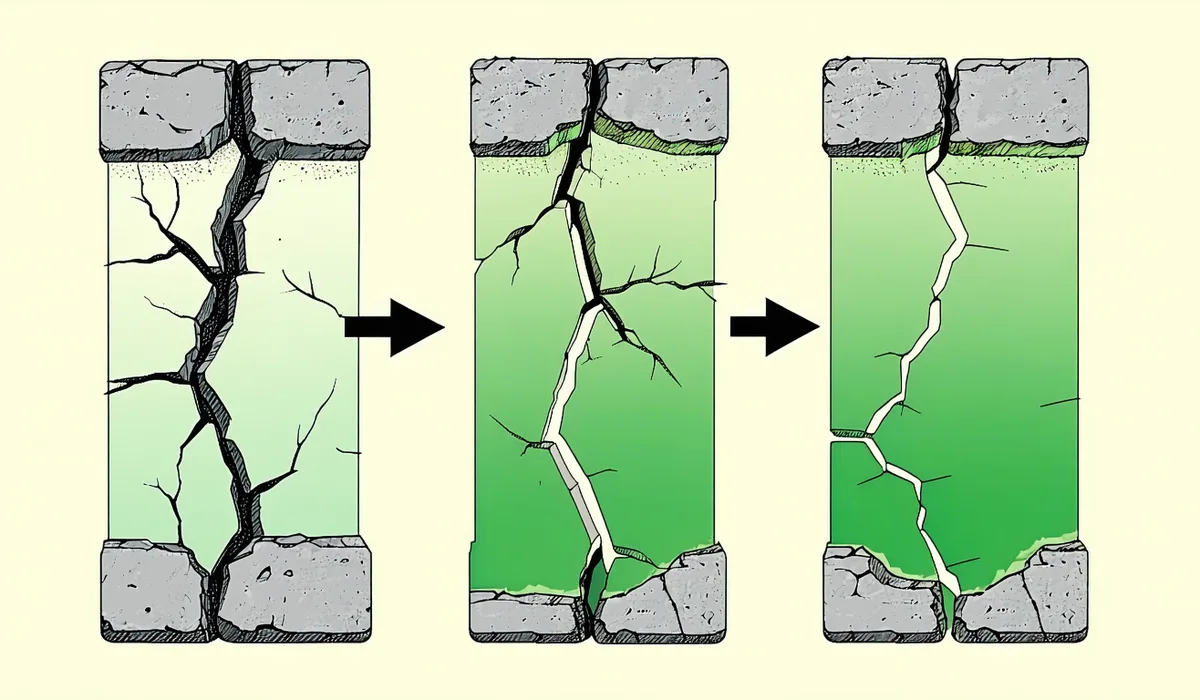
Autonomous crack sealing
The GX healing matrix consists of gel precursor compounds distributed throughout the cementitious matrix during mixing. When a crack forms and moisture contacts the healing zone, a controlled polymerisation reaction is triggered — the gel expands within the crack channel and sets into a load-bearing bridging material.
Unlike bacterial precipitation methods — which depend on organism viability across decades of concrete service — or unmodified autogenous healing, which is limited to very narrow crack widths in early-age concrete, the GX gel matrix is formulated for a defined target crack width range (0.05–0.40 mm), a predictable activation window, and repeatability across multiple crack-heal cycles in the same element. The mechanism does not require organism survival; the precursor is a stable dry additive added at the batch plant.
Explore the technology
Two parallel development tracks — gel-based crack sealing and low-carbon SCM formulation — designed from the start as a unified system rather than separate additive layers. Each sub-page carries full technical depth: target parameters, activation conditions, compliance-targeting language, and the framing a specifier needs to write GX into a project section.
Self-Healing Mechanism
Gel matrix chemistry, crack activation physics, performance envelope specifications, and the target test parameters we design against. Full technical depth for specification writers and structural engineers.
Learn moreLow-Carbon Formulation
Supplementary cementitious materials strategy, SCM selection rationale, target CO2 reduction pathways, and the compliance-targeting language suitable for LEED v4 and similar frameworks.
Learn moreReady to evaluate GX for a specific project?
Tell us the application, exposure class, and project stage. Our engineers will provide a project-specific technical brief — crack width envelope, recommended GX grade, and the specification language appropriate for the CSI section.