The Hidden Carbon of Maintenance: Why Self-Healing Reduces More Than Embodied CO2
When infrastructure owners and sustainability teams calculate the carbon footprint of a concrete structure, the analysis almost always stops at the gate — or at most at practical completion. Embodied carbon in the structural frame and enclosure, calculated from EPDs and bill of quantities, produces a kg CO₂e per square meter figure that gets entered into LEED certification worksheets or reported to boards as a green building metric. It is a useful number and it deserves the attention it receives. But it accounts for only a portion of the carbon the structure will be responsible for over its service life, and for infrastructure assets in particular, the omitted portion can be surprisingly large.
The Embodied Carbon Frame and Its Boundary Conditions
ISO 14040/14044 lifecycle assessment methodology defines system boundaries explicitly, and the most widely used system boundary for construction material carbon accounting — the cradle-to-practical-completion boundary — intentionally excludes operational use and end-of-life phases. This is a practical choice: operational carbon is more variable than embodied carbon, harder to attribute at design stage, and partly determined by future owner behavior rather than designer decisions. The boundary choice is defensible for design comparison purposes.
What it misses for long-lived concrete infrastructure is the maintenance cycle. A concrete bridge, parking structure, or retaining wall has a design service life of 50–75 years. Over that period, the structure will undergo inspection, minor repair, major repair, and possibly rehabilitation campaigns before eventual replacement. Each of those events has a carbon cost that the initial embodied carbon calculation ignores entirely. For assets in high-deterioration-rate environments — chloride exposure, freeze-thaw cycling, high traffic fatigue loading — the maintenance carbon tail is not a rounding error.
Anatomy of a Repair Campaign's Carbon Footprint
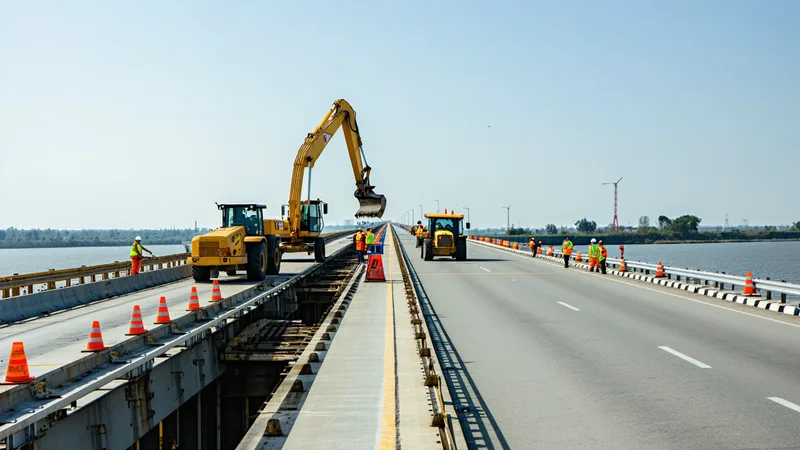
The carbon in a concrete repair campaign comes from categories that are rarely itemized together in sustainability analysis. Consider the components for a typical partial deck replacement or concrete spall repair on an urban interstate overpass:
- Mobilization transport: Inspection crew vehicles, equipment trailers, material delivery trucks, concrete mixer trucks. For a remote site or a structure accessible only with specialized equipment (scaffold, bucket truck), mobilization can require multiple round trips over a campaign that runs days to weeks.
- Equipment operation: Hydrodemolition equipment (diesel-powered high-pressure water pump systems), concrete saws, generators for lighting and pneumatic tools, vacuum extraction equipment for debris and water. Hydrodemolition for deck preparation is estimated to consume roughly 60–80 liters of diesel per 100 m² of deck area removed, depending on depth and equipment configuration — a significant carbon input for large-area repairs.
- Traffic management: Crash trucks idling for extended periods on live-traffic work zones, lane closure setup equipment, lighting towers for night work. A crash attenuator truck idling for a 12-hour overnight repair lane closure can consume 15–20 liters of diesel — and metropolitan infrastructure repairs may require 20–30 such closures for a single campaign.
- Repair material production and delivery: The patching mortar or repair concrete itself, including the embodied carbon of cementitious materials and admixtures, plus the delivery vehicle trip from batch plant or prepackaged mortar warehouse.
- Concrete for structural replacement zones: If deterioration has progressed to structural repair extent, the new concrete placed carries full embodied carbon including reinforcement steel.
For a representative 500 m² partial deck repair campaign, the sum of these components can fall in the range of 50–120 tonnes CO₂e depending on site access difficulty, repair depth, and equipment fleet. A major rehabilitation campaign on a significant bridge structure can reach several hundred tonnes. These are not incidental numbers — they are comparable to or larger than the initial embodied carbon reduction achievable by moving from a standard concrete mix to a well-optimized low-carbon mix with 40% SCM substitution on the same structure.
The Maintenance Interval Lever
Maintenance carbon is a function of two variables: the carbon cost per repair event, and the frequency of repair events over the asset's service life. Durability improvements that extend the interval between repair events reduce lifecycle maintenance carbon even if the per-event cost remains constant. This is the key insight that connects self-healing concrete to lifecycle carbon reduction: by closing micro-cracks before they progress to chloride ingress channels, crack-sealing chemistry delays the corrosion initiation event that triggers the first major repair campaign.
The quantitative relationship between healing performance and maintenance interval extension is application-specific and depends on exposure conditions, design details, and baseline crack frequency. We're not making claims about specific intervals for specific projects — that would require site-specific analysis. What the materials science supports is that reducing effective chloride ingress rate by maintaining crack closure under service conditions is directionally consistent with extending the time to corrosion initiation, and therefore with extending the interval before the first major repair campaign. Even a 5–7 year extension of a first major repair trigger point from, say, year 18 to year 23–25, represents a very different cash flow and carbon profile over a 50-year asset life — particularly when the avoided early campaign would have occurred during the structure's highest-traffic and highest-operational-value years.
Scenario: A State DOT's Portfolio-Level Carbon Model
Consider a plausible scenario for a mid-Atlantic state DOT managing approximately 3,200 bridges with concrete deck structures, of which roughly 800 are classified in the age cohort most likely to require first major deck maintenance within the next 15 years (built 1985–2000, in moderate-to-severe chloride exposure environments). Under conventional specification, annual deck maintenance mobilizations across this cohort run on the order of 60–80 campaigns per year at various scales. The combined operational carbon of those campaigns — equipment, materials, traffic management — is a material fraction of the DOT's total emissions inventory, though it is rarely calculated as such.
If 10% of new deck construction or major rehabilitation projects in this DOT's portfolio incorporated self-healing low-carbon concrete starting in 2026, the immediate embodied carbon reduction from lower-clinker mixes would be visible in the initial construction EPDs. The maintenance carbon reduction would not appear in any current reporting framework — but it would accrue as reduced mobilization frequency beginning 15–20 years from now, at the point where the conventional-specification decks in the same age cohort are triggering their first major campaigns. Lifecycle carbon accounting that includes this deferred maintenance effect would show a materially larger total carbon benefit than the initial embodied carbon reduction alone.
Scope 3 Infrastructure Emissions and the Accounting Gap
For infrastructure owners who report greenhouse gas emissions under GHG Protocol or equivalent frameworks, concrete maintenance activity typically appears as Scope 3 Category 12 (end-of-life treatment of sold products) for construction material manufacturers, or as operational capital expenditure emissions for asset owners. The lack of a standardized methodology for including maintenance carbon in infrastructure asset carbon accounts is a real gap in current practice.
Several frameworks are beginning to address this. The Infrastructure Carbon Review guidance from the UK, Whole Life Carbon Assessment standards (RICS Professional Statement 2023 edition), and emerging GRESB infrastructure assessment criteria are all moving toward lifecycle boundaries that include at least some maintenance carbon. The EU Taxonomy for Sustainable Activities' technical screening criteria for infrastructure explicitly reference service life extension as a climate mitigation activity — a regulatory signal that lifecycle thinking, including maintenance carbon, is moving into compliance territory.
For infrastructure owners and developers anticipating tightening lifecycle carbon disclosure requirements, investing in durability that reduces maintenance frequency is not just a sustainability position — it is a future regulatory compliance position. The accounting framework is still developing, but the direction is clear.
The Carbon Case for Specifying Right the First Time
The asymmetry in concrete's carbon profile — the specification decision is made once, but the maintenance consequences accumulate over 50 years — creates a structural mismatch between who bears the cost of a conservative initial specification and who bears the cost of the maintenance cycle it enables or prevents. In public infrastructure, the initial specification decision is made by a design engineer under a capital budget constraint; the maintenance consequences are borne by operations and maintenance budgets, often by different organizational units, sometimes by different political administrations.
Closing this organizational gap requires lifecycle cost and carbon tools that make the 30-year consequence of a year-zero specification decision visible at the time the decision is made. Those tools exist in various forms — FHWA's LCCA guidance for bridge structures, NCHRP research on pavement and bridge lifecycle cost methodologies, commercial LCC software used by large infrastructure owners — but they require maintenance carbon input data to function, and that data is still undercharacterized for self-healing concrete specifically.
Building that data set is partly a function of time — more deployed projects, more monitoring data — and partly a function of intent. Infrastructure owners who specify self-healing concrete with defined monitoring protocols for maintenance trigger events are directly contributing to the evidence base that will eventually make maintenance carbon a routine input to specification decisions. That is a genuine contribution to both the infrastructure industry's carbon reduction trajectory and to the commercial case for durable concrete technology.